
Your Career in Cybersecurity Starts Here
SOC Analyst Training, Internship & Placement Learn from Industry Experts Real-Time SOC Projects Placement Assistance Included Be Job-Ready in 120 Hours
Course Duration: 2 Months
Language: Hindi | English
Course Delivery: Online


Whats Included?
🎯
100% Placement Support
We ensure guaranteed placement support for every student.
👨🏫
Top Trainers
Each trainer has 13+ years of real industry experience.
📘
Practical Learning
Real-time virtual lab access from anywhere, anytime.
💻
Access Anywhere
Learn with just a laptop and internet connection.
👥
Collaborative Learning
One-on-one doubt clearing after every session.
🎯
Career Support & Interview Prep
Resume help, mock interviews, and placement guidance.
🛠️
Hands-On Tools
Work with SIEM, Nmap, Wireshark & other real tools.
💬
Live Doubt Clearing with Trainers
Get your queries resolved instantly through live interactive sessions with experts.
Certification on Completion
Receive an industry-recognized certificate to showcase your skills and expertise.
What you will learn in this course
We provide a very unique industry oriented curriculum from basics to an advanced level.

- Computer Network
- Types of Networks
- OSI model and TCP/IP model
- Network Devices (routers, switches, Hub, Bridges, Repeater)
- Network typologies(bus, star, mesh, ring)
- IP Addressing and Port Numbers
Subnetting - Network Protocols (TCP, UDP, ICMP, DNS, DHCP, HTTP, FTP,
SMTP, SNMP, SSH) - Network segmentation and DMZs
- Load balancing and failover techniques
- Network monitoring and logging techniques
- Cryptography Fundamentals
- Encryption & Decryption
- Encoding & Decoding
- Hashing & Hashing Functions
- Cryptographic Algorithms
- Symmetric Encryption
- Asymmetric Encryption
- Digital Signatures
- Cryptographic Key Management
- Transport Layer Security (TLS)
- Secure Sockets Layer (SSL)
- Cryptography in Network Security
- Cryptography in Storage Security
- Cryptography in Cloud Security
- Cryptography in Mobile Security
- Cryptography in Email Security
- Cryptography in Identity and
- Access Management
- SIEM Concepts and Architecture
- Splunk Installation
- Event Sources and Log Management
- Event Correlation and Normalization
- Use Cases Writing and Fine-Tune
- Threat Detection and Alerting
- Proactive Monitoring and Triage of Security Events
- Compliance Reporting and Auditing
- User and Entity Behavior Analytics (UEBA)
- Machine Learning and Artificial Intelligence in SIEM
- Data Analytics and Visualization
- Log Collection and Processing
- Monitors health of Security Sensors and SIEM Infrastructure.
- Generate and Delivered Reports- Daily, Weekly Monthly Working with Dashboards
- Network Security Fundamentals
- Firewall technologies
- IDS/IPS
- Network Segmentation
- Network Access Control (NAC)
- Network Traffic Analysis using Wireshark
- Virtual Private Network (VPN)
- VPN Protocols
- Network Scanning
- Vulnerability assessment
- Network attack & Types
- Network forensics and IR procedures
- DNS security technologies
- Introduction to Malware Analysis
- Types of Malware (viruses, worms, trojans, rootkits, ransomware and more)
- Malware Analysis Techniques
- Setting up the Sandbox for Malware Analysis
- Malware Detection and Prevention
- Malware Functionality
- Indicators of Compromise(IoC)
- Email indicators
- Network indicators
- Host-based indicators
- Behavioural indicators
- Malware Removal Techniques
- Malware Mitigation
- Malware Research
- Malware Case Studies
- Endpoint Security Concepts and Architecture
- Malware and virus Detection and Prevention
- Host-based Intrusion Detection and Prevention
- Firewall and Network Protection
- Application Control and Whitelisting
- Patch Management and Vulnerability Assessment
- Data Loss Prevention
- Device Control and USB Blocking
- User Behavior Monitoring and Analytics
- File Integrity Monitoring (FIM)
- Endpoint Detection and Response (EDR)
- Forensics and Investigation of Endpoint Incidents
- Web Application Architecture
- HTTP Communication
- HTTP Methods
- HTTP Requests and Responses
- HTTP Headers
- Cookies and Sessions
- URL Encoding
- Caching
- Proxies and Gateways
- HTTPS (SSL/TLS encryption and certificate authentication)
- Web Application Security Techniques
- Web Application Firewall (WAF)
- Incident Classification and Prioritization
- Incident Notification and Communication
- Evidence Collection and Preservation
- Threat Analysis and Intelligence Gathering
- Memory analysis and volatile data collection
- Preparation
- Detection and Reporting
- Triage and Analysis
- Containment and Neutralization
- Eradication Business Continuity and Disaster Recovery Planning
- Post-Incident Activities
- Patch Management and System Hardening
- Legal and Regulatory Considerations
- Network and host forensics
- Cyber Kill Chain
- MITRE ATT&CK Framework
- Malware infections: Viruses, Trojans,
- Ransomware
- Phishing Attacks
- Spear-phishing Attacks
- Social Engineering Attack
- Phishing email Analysis
- Email Header Analysis
- Denial-of-service (DoS) attacks
- Brute-force attacks
- Account compromised
- Unauthorized access
- Data breaches
- Advanced persistent threats (APTs)
- Website defacements
- Man-in-the-Middle Attack
- SQL Injection Attack
- Password Attack
- Web Attacks
- IOC-Indicator of Compromise
- URL Analysis
- IP Analysis
- Insider threats
- Threat Hunting Methodology
- Types of Treat Hunting
- Threat Hunting Use Cases
- Threat Hunting Tools
- Threat Hunting Scenarios
- Threat hunting Metrics
- Behavioral Analysis
- Use of Threat Intelligence in Hunting
- Data Collection and Analysis
- Review threat intelligence feeds and investigate on identified potential indicators of compromise (IOCs)
- Collaboration and communication
Integration with SIEM, EDR
- Threat Intelligence Sources
- Threat Intelligence Platforms
- Threat Intelligence Analysis
- Threat Modeling
- Threat Intelligence Sharing
- Threat intelligence Integration with Security Tools (such as SIEM, Firewall, Proxy, Email Gateway, and EDR)
- Identify and Ingest Indicators of Compromise (IOCs) Into
Applicable Security Controls - Review Detection Coverage of IOCs
- IOCs submission for coverage
- Vulnerability Assessment
- Vulnerability Management Life Cycle
- Nessus Installation
- Scan Prerequisites
- Vulnerability Scanning
- Credential scan and Non-Credential scan
- Vulnerability Prioritization
- Vulnerability Remediation
- Patch Management
- Reporting and metrics
- Asset Management
- Importance of Ethical hacking
- Skills of an ethical hacker
- Bug Bounty Program
- Types of Hackers: Black Hat, White Hat, Grey Hat, Script Kiddies, Hacktivists, State-Sponsored.
- Types of Ethical Hackers
- Red Team
- Blue Team
- Penetration testing life cycle
- Reconnaissance
- Vulnerability scanning
- Exploitation
- Privilege escalation
- Post-exploitation
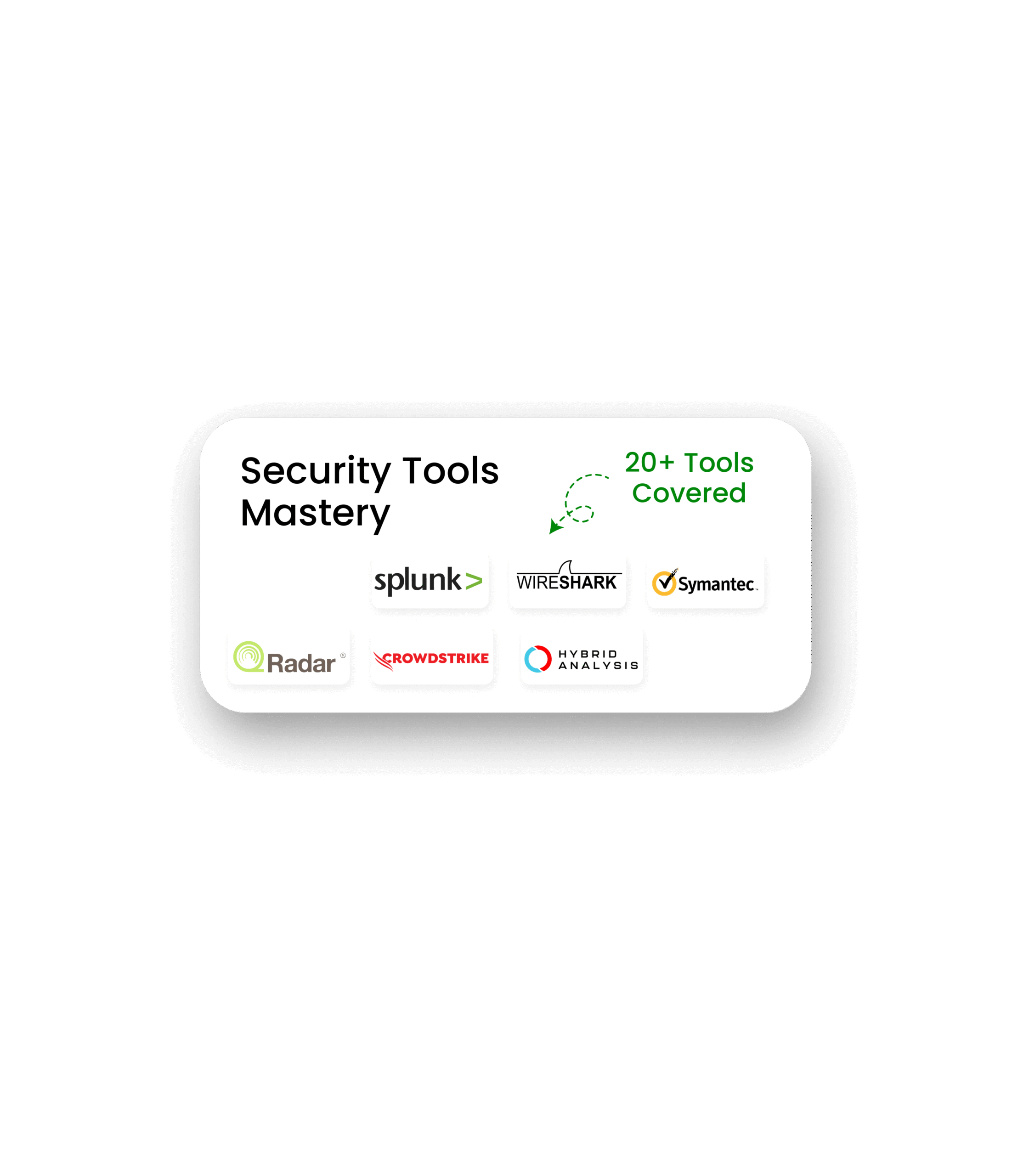
Security Tools You Will Learn In Training












+ many more
Need Help? Check Our FAQs
What is a Security Operation Center (SOC)?
A Security Operations Center (SOC) is an essential component of a data protection and security system that helps lower the level of risk that information systems face from external and internal threats.
What does a SOC Analyst do?
A SOC Analyst monitors an organization’s network and systems for potential security threats, analyzes and investigates incidents, and provides remediation guidance. They also create and maintain security documentation, perform vulnerability assessments, and develop incident response plans.
What are the career prospects for SOC Analysts?
The demand for SOC Analysts is expected to grow rapidly in the coming years as more organizations prioritize cybersecurity. SOC Analysts can also advance to higher-level positions such as SOC Manager or Chief Information Security Officer (CISO).
What topics are covered in a typical SOC Analyst course?
A typical SOC Analyst course covers topics such as threat detection and analysis, incident response, vulnerability assessments, security tools and technologies, and security documentation and reporting.
What is the role of a SOC Analyst?
A SOC Analyst is a member of the cybersecurity team in charge of monitoring and combating threats to a company’s IT infrastructure. They are at the forefront against security threats, and they are responsible for evaluating security systems, discovering and repairing vulnerabilities, and increasing cyber resilience.
DO you provide the any certificates for SOC Analyst training course?
Yes, CyberSecXperts will provides a course completion certificate after the successful training session. SOC Analyst Certification Course have great value in Job market.
Does Cyber Security require coding?
Many candidates ask this question if Cyber Security field requires programming knowledge? No, even 95% of cyber security professional does not have programming knowledge and they are successful in their career.
Are you looking to start your career in Cyber Security but not sure how to start?
You can call us or send the us an inquiry using the website contact, our Cyber Security Experts will help to guide and provide the complete idea about Cyber Security and how you can start the your career in Cyber Security.
Does CyberSecXperts offer job assistance?
Yes ! We will provide 100% job assistance to candidates who have effectively finished the Training course. For this, we are tied-up with top MNCs from around the globe. Along these lines, you can be put in extraordinary associations.